The Rupture: No condition is permanent
-
Talbot Rice Gallery, University of Edinburgh
Inside-Out Art Museum, Beijing
Museum of Contemporary Art and Design, Manila
The Rupture is an international collaborative project bringing together Talbot Rice Gallery of the University of Edinburgh, Inside-Out Art Museum in Beijing, and the Museum of Contemporary Art and Design in Manila. Conceived by Tessa Giblin and Carol Yinghua Lu, with Joselina Cruz completing the curatorial partnership, the project responds in real-time to a world undergoing profound political, social and economic change, echoing Mark Carney's declaration "we are in the midst of a rupture,” in his 2026 Davos address. Curated in three episodes, The Rupture will launch at Talbot Rice Gallery in October of 2026, nine months after Davos.
The Rupture: No condition is permanent
Taysir Batniji, Jenny Brady, Dasha Chechushkova, Jasmina Cibic, Kiri Dalena, Zhanna Kadyrova, Roman Khimei and Yarema Malashchuk, Tarik Kiswanson, Eoghan Ryan, Margaret Salmon, Astra Taylor, Li Yifan, Carey Young, Claudia Zeiske and Song Ziwei
At a time of profound global uncertainty, The Rupture: No condition is permanent asks what it means to live through the breakdown of established systems, rules-based order and global relationships. Amidst the rise of generative AI, neo-colonial threats, the reality of war and growing economic inequality, we also face the escalating effects of climate change that knows no borders, causing extreme weather and planetary events around the world. As nations attempt to align, find common ground around shared values and act in the interests of the future, the exhibition brings together artists from different cultural contexts, and explores the changing reality of our time from a position of hope. Across the collaboration, artists give voice to the voiceless, draw our attention to the means of our manipulation, reveal hidden constructs beneath our lives and share their lived experience of this rupture. In abstract and complex ways, they insist that the world is ours to change — that no condition is permanent.
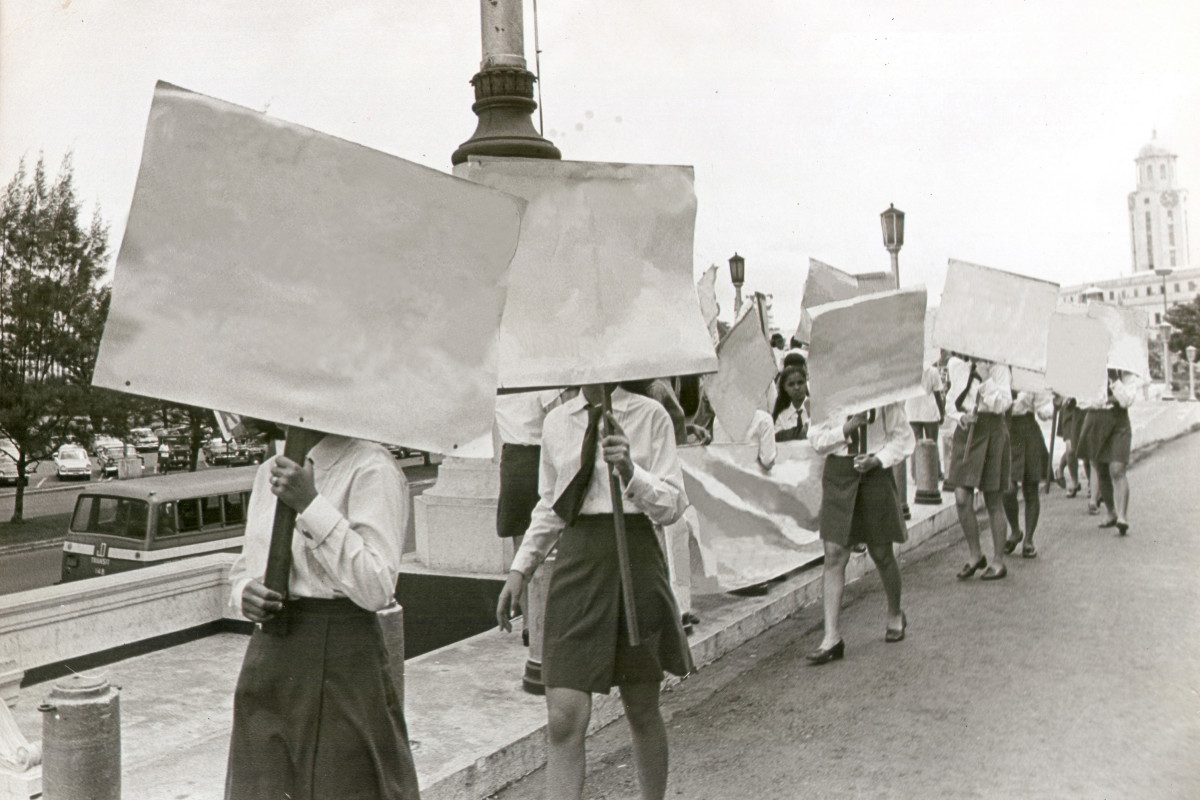
With a number of artworks exploring communication, language and the power of the image, we travel through Manila, Seoul, Dublin and New York. Eoghan Ryan unpacks signs, symbols and signifiers utilised in public space, Astra Taylor reminds us of the joy of ethics and philosophy in the urban jungle, and Jenny Brady surveys the act of interpretation, while Kiri Dalena visualises censorship and imagines the potential of future protest movements.
Resonating with Dalenas’ photographic series are a group of artworks that further express the perspectives of those who are unseen or erased. With a sigh that escapes as puff of smoke, Song Ziwei evokes the loneliness of isolation amongst her generation of workers, and covid-era newsfeed saturation. Li Yifan gives voice to the precarious lives of Chinese migrant workers and against increasing existential concern about the rise of artificial intelligence, he utilises AI to transmit these workers’ stories across gaping societal divides.
Visualisations of the law, the post-war birth of intergovernmental organisations and institutions upholding a rules-based order are evoked. Works of Jasmina Cibic refer to the non-aligned movement and global migration through birdsong, Carey Young portrays figures of the law as well as the frustration of discourse within the UN, whilst we encounter a yearning for the core values and purpose of the European Union amidst a backdrop of displacement in the work of Tarik Kiswanson, and an international treaty and security guarantees are critiqued in the work of Zhanna Kadyrova.
Kadyrova’s installation joins other artists who have a lived experience of war, conflict and occupation. Roman Khimei and Yarema Malashchuk project the impact of Russia’s full-scale invasion of Ukraine into the future, exploring ideas of guilt, culpability and remorse, while Dasha Chechushkova mourns lives lost in Ukraine, expressing the complexity of emotions for those who navigate the war on a daily basis. Claudia Zeiske pays homage to the cultures and cuisines of people around the world experiencing conflict through a new Combat Cooking recipe booklet. Margaret Salmon’s new work summons family military histories amidst ideas of ontological security, while Taysir Batniji negotiates the harrowing reality of a lifetime of exile and displacement with generosity and hope, in the form of a sculpture of soap doomed to vanish with time.
Curated by Prof Tessa Giblin, with contributions from Carol Yinghua Lu
The Rupture: No condition is permanent at Talbot Rice Gallery is supported by Creative Scotland, Edinburgh College of Art and British Council. Jasmina Cibic's artwork is supported by the Cultural Fund, which promotes Slovenian culture internationally and is administered by the Slovenian Embassy in London.
The Rupture: No condition is permanent, Talbot Rice Gallery, University of Edinburgh, UK from 23 Oct 2026 - 13 Feb. 2027. Curated by Tessa Giblin with contributions from Carol Yinghua Lu.
The Rupture: It is then, but it is also now, Inside-Out Art Museum, Beijing, China from 7 March - 27 June 2027. Curated by Carol Yinghua Lu with contributions from Tessa Giblin and Joselina Cruz.
The Rupture: Enough chaos to make another world, Museum of Contemporary Art and Design, De La Salle – College of Saint Benilde, Manila, Philippines from 4 March - 6 June 2027. Curated by Joselina Cruz with contributions from Carol Yinghua Lu and Tessa Giblin.
Exhibition Guide